Education is not merely preparation for the labor market. At its core, it is an act of intergenerational transmission: the handing down of knowledge, values, and cultural assets from one generation to the next, in order to preserve continuity and encourage further creation and development. Throughout history, human societies have understood that a child needs anchors—a story larger than himself, a tradition that precedes him, and the knowledge that he is a link in a long chain of learning, effort, and responsibility. The wisdom of the generations, Jewish and Zionist history, and cultural heritage are not only sources of identity and belonging; they also constitute an essential intellectual infrastructure. They build a conceptual language, cultivate complex thinking, and provide a broad framework for understanding both local and global reality. An education grounded in systematic and cumulative knowledge does not narrow the student's world; on the contrary, it expands it. It develops independent learning skills, well-grounded critical thinking, and the capacity for sustained intellectual engagement, enabling young people to confront the challenges of the present and the future with confidence and understanding rather than improvisation. From this perspective, it becomes clear that a Zionist-conservative approach to education is not an exercise in nostalgia, but a long-term investment in shaping thoughtful, resilient, and responsible individuals—deeply rooted, yet capable of growing securely toward the future.
The Institute for Zionist and Traditional Education
Hanokh is an independent educational institute seeking to strengthen the dimensions of knowledge, identity, and cultural depth within Israel's education system.
Background
In recent decades, two troubling trends have undermined the quality of education provided to Israel's children.
First
The growing influence of academia—exerted through professional committees, teacher-training institutions, and the approval of curricula—has significantly diluted the Jewish and Zionist components of state education. As a result, most Israeli students complete their schooling with only minimal familiarity with Jewish history and tradition. In place of particularistic national values and the cultivation of a rooted, robust identity, the emphasis has shifted toward generalized "civic" values such as sustainability, tolerance, and individual self-fulfillment.
Second
Educational ideas that were once considered alternative or marginal have successfully penetrated the mainstream of educational thought in Israel. Knowledge has given way to experience; the teacher has been recast as a mentor with diminished authority and status; and the system now focuses primarily on promoting amorphous skills such as creativity, teamwork, and critical thinking—often at the expense of linguistic, conceptual, historical, scientific, and cultural knowledge. The result is a generation growing up with little exposure to the core assets of Jewish heritage and the great achievements of human civilization.
Needless to say, these two trends are deeply intertwined. Identity is built through knowledge and through the cultivation of a sense of belonging and purpose. Cultural literacy grounded in a canon and tradition is a precondition for a strong and flourishing society composed of free, committed, and contributing citizens. Skills relevant to the labor market are secondary in importance to identity formation, character development, and the strengthening of social cohesion—though they, too, ultimately draw nourishment from these deeper foundations.

The Vision
The establishment of an educational institute with a Zionist and traditional orientation, dedicated to restoring a neglected legacy: advancing conservative educational thought, returning the enrichment and deepening of knowledge to the center of educational practice, and creating the tools needed to cultivate a rooted and profound Zionist identity among Israel's students.
The Institute will nurture a unique cadre of teacher-educators, researchers, and leading educators—individuals deeply versed in classical educational philosophy, the history of Zionist education, and contemporary conservative thought. This group will serve not only as lecturers and trainers, but as living models of educational excellence: instruction that is knowledge-rich, precise, systematic, intellectually rigorous, and firmly connected to tradition. Over time, the Institute will become an intellectual-practical home that sets a new standard for educational excellence. At the institutional level, the Institute will seek recognition as an independent pedagogical body. It will develop and lead prestigious professional development programs for outstanding teachers and school principals, and offer academic courses in collaboration with teacher-training institutions. In the long term, the Institute will work to establish foundational training tracks for exceptional educators and to grant prestigious teaching certificates— reflecting not only compliance with formal requirements, but a deep commitment to knowledge, educational responsibility, and Zionist mission. Once established as Israel's leading and most respected body for the training, mentoring, and professional development of educators, and once a distinctive community of teachers and principals—proud of their profession and mission—has coalesced around it, the Institute will serve as a model for other training organizations. In this way, it will seek to attract Israel's social and intellectual elite back into the field of education, restore the prestige of teaching, and bring about a profound shift in the public understanding of education in Israel.
The Institute's Unique Position in Israel's Educational Landscape: Barriers, Opportunities, and Added Value
Over the past several decades, the intellectual dominance of academic institutions has led to the near-total prevalence of progressive educational paradigms in Israel's state education system. This dominance has been accompanied by a weakening of the status of knowledge and authority, and by a systematic erosion of Jewish-Zionist identity components within public education. The Institute for Zionist and Traditional Education seeks to operate as an independent intellectual and pedagogical institution, offering a coherent and principled alternative to the prevailing educational discourse - one grounded in serious thought, research, and practical implementation. Unlike ad hoc initiatives, organizations focused solely on identity, or short-term professional development programs, the Institute's distinctiveness lies in its integration of classical educational philosophy, applied pedagogy, the cultivation of young intellectual capital, and sustained, long-term influence on educational discourse, policy, and the training of teacher-educators. To date, no comparable institutions have emerged in Israel. This absence is the result of several converging factors: centralized academic control; a lack of economic incentives for deep, non–credential-granting educational initiatives; and public reluctance to engage systematically with questions of identity, tradition, and canon. In addition, the long-standing struggle between secular and religious communities over educational hegemony has shaped the field in counterproductive ways. Over time, leaders within the secular public sphere have narrowed their engagement with Jewish identity, national Zionism, and tradition, while leaders within the religious sector have often refrained from developing a robust engagement with Western educational philosophy and research-based pedagogy. Paradoxically, this very reality has created a unique opportunity. There is a growing sense of intellectual fatigue - and a corresponding hunger - among teachers, school leaders, and educational professionals for a different kind of professional language: serious, intellectually rigorous, and unapologetic. Alongside this hunger is an increasingly widespread recognition that Israel's educational challenges require deep structural change, not cosmetic adjustments. Investment in the Institute at this stage is therefore not the funding of a one-time program. It is a careful and deliberate effort to establish a durable institutional foundation - one with the potential to exert broad and lasting influence on Israel's educational culture, policy, and leadership for years to come.
Core Areas of Activity
Intellectual and Research Activity
Cultivating a renewed educational philosophy that challenges the progressive orthodoxy dominating contemporary educational discourse. This includes the import, translation, adaptation, and dissemination of conservative educational thought, alongside original research and publication. Activities will include scholarly articles, original books, and the translation of influential works from other languages.
Education Policy
Advancing the Institute's educational principles within government and public institutions, influencing pedagogy and resource allocation within the Ministry of Education, and promoting a conservative educational agenda at the policy level.
Pedagogy
The development of curricula, readers, lesson plans, assignments, assessments, and high-quality evaluation tools. This also includes the creation of non-formal educational materials for ceremonies, field trips, and extracurricular activities. All materials will be knowledge-based, conceptually coherent, and intellectually demanding. This pedagogical work will not be framed as supplementary "teaching aids," but as a substantive alternative body of content offering a distinct educational language to the system as a whole.
Professional Training
The design and delivery of training programs for teachers and school leaders inspired by the Institute's educational philosophy, as well as in-service professional development. Through these activities, a prestigious community of Institute alumni will be formed, maintaining ongoing professional ties and mutual support, and enriching both their own educational practice and that of their students.
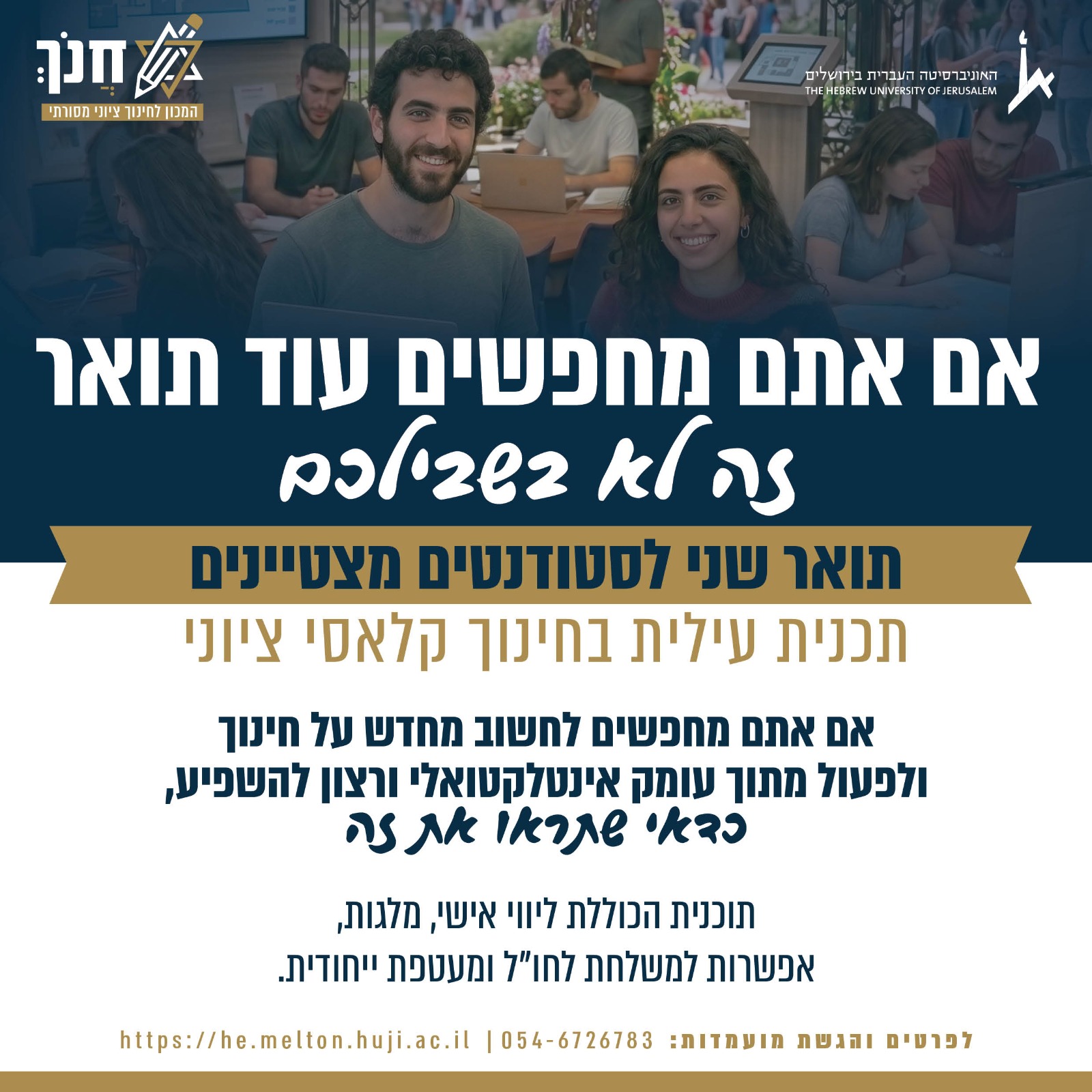
Master's Degree for Outstanding Students in Classical Zionist Education
In partnership with the Milton Center at the Hebrew University. The program is designed to train outstanding students in the fields of education and educational policy.
Want to stay updated on our activities? Subscribe to our newsletter
An intellectual and professional community of educators, researchers, and institutional partners.
Public Council

Dr. Amit Baratz
Dr. Amit Baratz holds a doctorate in Classical Studies. He teaches in the International Program at Tel Aviv University, focusing on ancient Greek culture and the teaching of philosophy, history, and literature of the classical world.

Dr. Oz Blooman
Dr. Oz Blooman, married to Tzofia and father of several lively children, teaches at the Birkat Moshe hesder yeshiva in Ma'ale Adumim and at Bar-Ilan University. He directs the Kedem Center and serves as editor of the journal Religion: A Home for Religious Thought. He lives in Mevaseret Zion.

Anat Kanfo
Former Knesset member and public activist. Previously served as a Member of Knesset and Deputy Head of the Har Adar Council, with senior management experience in the high-tech industry (Mobileye). She led and drafted the National Council for Education Law as part of a vision for improving governance in Israel.

Dr. Alon Shalev
Dr. Alon Shalev is a research fellow at the Kogod Center and a visiting scholar at the Jonathan Zaks Institute at Bar-Ilan University. His work focuses on the question of the meaning of life in Jewish thought and philosophy, political thought, and the intersections between them. His book on the theology of the quest for meaning in the life and thought of Rabbi Isaac Hutner, Pahad Yitzchak, was published by Brill. He lives in Tzur Hadassah, is married, and is the father of three.

Dr. Asael Ablman
Dr. Asael Ablman is a historian of Jewish history and an author. He teaches Jewish history at the Shalem Academic Center and at Herzog College, where he formerly headed the Department of History. He has published academic articles and pieces in newspapers and popular journals in Israel, edited The Judgment of History: Selected Articles by Gertrude Himmelfarb (Shalem Press, 2018), and published four books.

Rabbi Dr. Mitchell Rocklin
Rabbi Dr. Mitchell Rocklin is Academic Director and Dean of the Lobel Center for Classical Jewish Education. He received his doctorate in history from the CUNY Graduate Center and has taught at CUNY and Princeton. He serves as a military rabbi in the U.S. Army at the rank of Lieutenant Colonel. He is also President of the Jewish Coalition for Religious Liberty and serves on the Board of Directors and Military Rabbinical Committee of the Rabbinical Council of America. Before joining the Tikvah Fund, he served as a community rabbi in Connecticut.

Dr. Gali Sembira
Former CEO of the Government Press Office, CEO of the Yitzhak Navon Foundation, CEO of Shaharit, professional director at Shitufim, Deputy CEO of the Oren Foundation, and head of the at-risk girls field in the national YANIV program. She designs processes for social impact in government ministries and civil society, with extensive experience in learning design, leadership development, and the establishment and management of social and community organizations.

Rabbi Chaim Navon
Rabbi Chaim Navon is a thinker, author, educator, and publicist. For many years he has taught at Yeshivat Har Etzion, at the midrasha at Bar-Ilan University, and at the Lindenbaum Midrasha. He has published nineteen books on Judaism, education, and thought, and writes a weekly column in Makor Rishon.
Leading Team

Tomer Avrum
Tomer Avrum, married to Naomi and father of four, lives in Tekoa. He serves as Head of the Education Policy Department at the Kohelet Forum. He writes and lectures on education, identity, economics, and security. He holds a degree in social sciences and security from Bar-Ilan University and is certified in public policy from the Hebrew University. Lieutenant Colonel (Res.) in the IDF.

Tzvia Shiff
Lecturer at the Etros Center for Leadership and Management. Expert in strategic consulting and business development, with diverse experience in content development, initiating and accompanying projects in the business and social sectors. She lectures and teaches in various frameworks. Previously served in key roles in the Knesset and government, and for years accompanied the business arm of a leading law firm. She holds BA and MA degrees from the Faculty of Law at Bar-Ilan University (LL.B, LL.M). Married to Rafael and mother of four.
Join Us
Academic Collaborations
The Institute for Zionist and Traditional Education is proud to collaborate with leading academic institutions to ensure the highest standards of educational training and research.
Milton Center, Hebrew University
The program is designed to train outstanding students who wish to make an impact in the fields of education and educational policy.